


Driveway Pressure Washing in Honolulu That Restores, Not Replaces
Why Honolulu Driveways Get Dirty Faster
Honolulu's warm, damp weather lets algae and mildew grow all year. Iron-rich red dirt, salt air, and oil baked in by strong sun add stains on top of that. Most of this buildup sits in the surface of the concrete, not deep in the slab, so cleaning usually fixes it and replacing isn't needed.
If your driveway looks dirty again soon after you cleaned it, it's not your imagination, and it's usually not a sign that the concrete is failing. It's the island. Several things work on a driveway here at the same time, and they don't take a season off.

Concrete is porous. It's full of tiny pores that soak up water, dirt, and oil. In Honolulu, those pores are almost always being fed something.
Warm, humid air all year. Places with cold winters get a natural break when freezing weather slows mold and algae. Oahu doesn't. Green and black growth can keep spreading every month of the year, especially in spots that stay shaded or damp.
Rain that comes back before the slab dries. Trade-wind showers can roll through again and again, and wet valleys like Mānoa and Nuʻuanu get more rain than homes near the shore. A driveway that rarely dries out completely is a good home for algae and mildew.
Red dirt. Oahu's iron-rich soil washes off yards, planters, and work sites onto the concrete. It leaves orange and rust-colored stains that settle into the pores, and a garden hose won't lift them.
Salt air. Near the coast, salt settles on outdoor surfaces and leaves a film that holds onto dirt and moisture.
Strong sun on oil. Drips from cars and trucks don't just sit there. The heat helps them spread and soak deeper, so a small spot under the engine can turn into a wide, dark patch.
Leaves, flowers, and fruit. Trees that drop leaves, flowers, or fruit onto the driveway leave tannin stains and food for mildew as they break down.
Put those together and you get the pattern most Honolulu homeowners know well. The sunny middle of the driveway fades and looks dull. The edges near the lawn and the shaded strip beside the house turn green or black. A rusty fan spreads out from the planter. And there's a dark patch right where the car parks.
This matters for more than looks. Algae and mildew make concrete slippery when it's wet, and in a place where showers come and go, that's a real fall risk for family, tenants, and guests. Growth that's left alone also holds moisture against the surface for longer.
Here's the good news. Nearly all of this is surface buildup. The slab under it is often in fine shape. That's why a driveway that looks like it needs replacing can usually be brought back with the right cleaning. Each type of buildup needs its own approach, though. Spraying everything with more pressure doesn't work, because red dirt, oil, and organic growth each react differently. A cleaning that only removes the top layer can leave the roots of the growth behind, and that's how a driveway goes green again within weeks.
Deciding Between DIY and Professional Driveway Cleaning
Here's the honest answer. Light dirt and fresh spills are often a do-it-yourself job. Deep stains, heavy growth, and big areas usually aren't. The real question isn't whether you can rent a pressure washer. It's whether the job needs more than the top layer cleaned off, because that's what decides if your driveway stays clean or turns green again within weeks.
You can probably handle it yourself if:
The driveway mostly has loose dirt, leaves, or dust on it.
There's a fresh oil drip you caught early, before the sun had time to spread it.
A little green is starting in one shaded corner, not across the whole slab.
The driveway is short, flat, and easy to reach with a hose.
You just want it tidy for guests and aren't trying to remove old stains.
In those cases, a stiff broom, a hose, and a cleaner made for concrete can do the job. If that's where you are, there's no need to call anyone yet. Keep an eye on the shaded edges and the parking spot, and give them some attention every so often.
A professional cleaning makes more sense if:
Red dirt stains have settled in and a hose doesn't change them.
The oil patch under the car is wide, dark, and old.
Green or black growth covers the edges or large parts of the slab.
You cleaned it yourself and it came back fast.
The driveway is long or sloped, or it connects to walkways and a patio.
You manage rental units and need slick spots dealt with before a tenant or guest slips.
Renting a machine is where a lot of weekend projects go wrong. Pressure washers are strong, and concrete is softer than it looks. Hold the tip too close or stay in one spot too long, and you can etch the surface. That leaves rough patches that hold dirt even faster. Uneven passes leave light and dark stripes across the slab that are easy to see from the street. And more pressure alone won't lift rust-colored dirt or old oil. Each stain needs the right approach, as covered above, and blasting away at it mostly wears down the concrete.
Think about your time too. A full driveway can take most of a day for someone who doesn't do it often. That means hauling the rental, hooking it up, working in the sun, and cleaning up. If you finish and the stains are lighter but still there, you've paid for the rental and you'll still be looking at the same driveway.
If you're not sure which side you're on, a free estimate is a low-risk way to find out. When Aqua Grout & Powerwash cleans a driveway on Oahu, we document the work with photos from start to finish, so you can see exactly what changed. Our work is also backed by a 180-day warranty. If we look at your driveway and think a broom and a hose will do the job, we'll tell you that.
Explore our pressure washing for Honolulu properties.
How Professional Driveway Pressure Washing Works
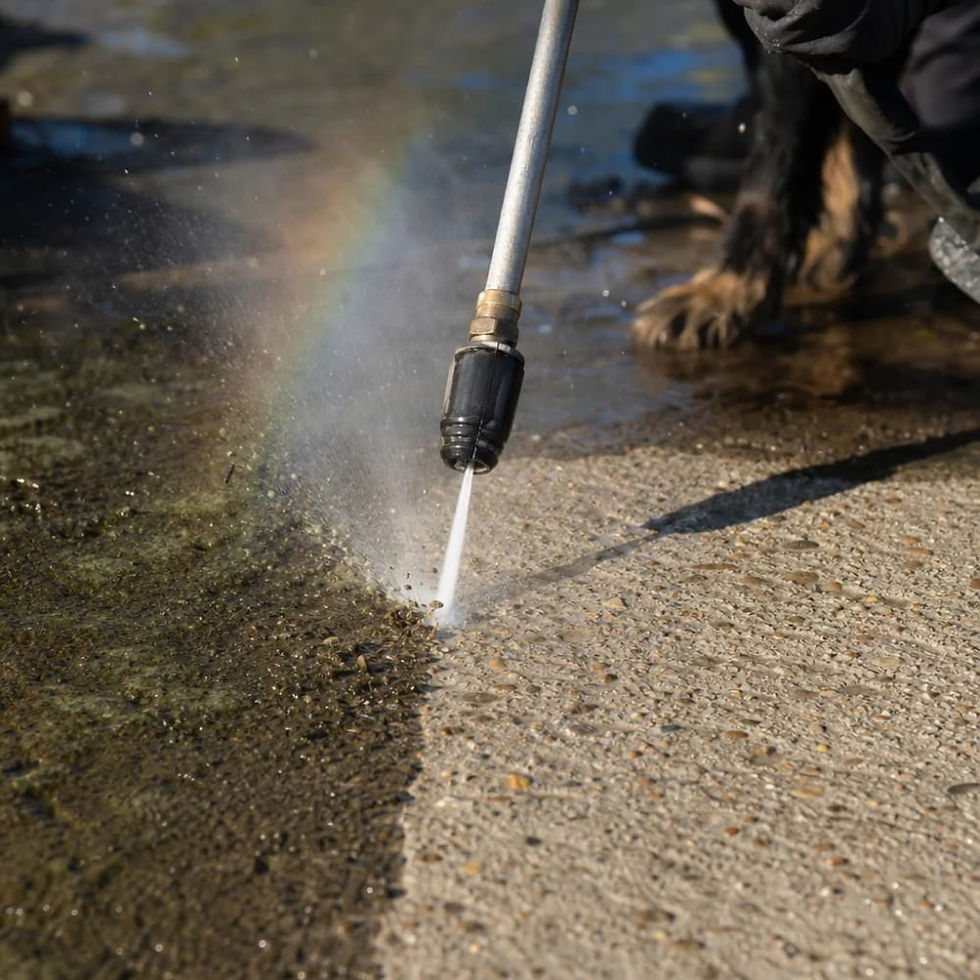
A good driveway cleaning isn't one long blast with a hose. It's a short series of steps, and each one does a different job. Skip one, and you get the patchy, short-lived result that sends people back to the rental shop.
Here's what a thorough professional job should include:
A look at the slab first. Before any water hits the concrete, the cleaner should walk the driveway and note what's there: green edges, rust-colored fans from planters, the oil patch, cracks, and loose or flaking spots. Older or worn concrete needs a gentler touch than a newer slab.
Pretreating each stain on its own terms. Growth, red dirt, and oil don't respond to the same thing. Each gets the right cleaner and enough time to work before rinsing. This step does most of the heavy lifting, so the machine doesn't have to.
Even cleaning across the whole surface. The main slab should be cleaned in steady, overlapping passes at a consistent distance, so you don't get the light and dark stripes or etched patches that come from a wand held too close.
Detail work on edges and joints. The seams, expansion joints, and the strip along the lawn are where growth hides. They need separate attention, or they'll be the first places to go green again.
A full rinse and a post-treatment where needed. Rinsing carries loosened grime off the slab. Areas with heavy growth may get a follow-up treatment that reaches what the pressure didn't, which helps slow regrowth in shady spots.
A final walk-through. The driveway should be checked once it starts to dry, because some stains show up better then. Any spot that needs another pass gets it before the job is called done.
Where the water goes matters too. In Honolulu, rain and rinse water that run into the street drain head toward streams and the ocean. A careful cleaner controls runoff and doesn't send oily, soapy water straight down the gutter. It's fair to ask any provider how they handle it.
There are also a few things you can do to make the day go smoothly:
Move cars, bikes, and trash bins off the driveway the night before.
Turn off sprinklers that hit the concrete, so the slab isn't wet and muddy.
Close nearby windows and garage doors, and keep pets inside.
Point out delicate plants, outdoor lights, or anything loose along the edges.
If you manage a rental, give tenants notice so they can park somewhere else.
Most residential driveways are done in a few hours, depending on size, slope, and how much buildup there is. The concrete usually dries by the end of the day, though shaded areas take longer in damp weather.
A better test than a quick look is how the driveway holds up afterward. A properly cleaned slab should look even from one end to the other, with no stripes and no rough, etched patches. The edges should be clean down into the joints. That's the reason for the start-to-finish photos mentioned above. You can compare the before and after shots yourself, not just take someone's word for it.

Handling Wash Water Responsibly Near the Coast
Since rinse water that reaches the street ends up in streams and the ocean, the real question is what's in that water and how much of it leaves your property. A driveway wash in Honolulu can carry oil, brake dust, red dirt, cleaner residue, and broken-down leaves. One house doesn't add much. Thousands of driveways rinsed into the gutter add up, and the storm drain system isn't a treatment plant. What goes in is what comes out.
This hits harder on an island. Muddy runoff clouds the water near shore, and oily residue doesn't belong anywhere near a reef or a beach where your kids swim. Red dirt is a good example. It's natural soil, but when it washes off in large amounts it settles where it shouldn't. Keeping it on your property is better for the water and better for your driveway, since less of it gets tracked back onto the slab.
Careful handling mostly comes down to reducing what washes off and choosing where the water goes. Before you hire anyone, ask:
Will you sweep up loose dirt, leaves, and red soil before washing, so it doesn't all get flushed toward the street?
How do you handle old oil stains? Soaking up and removing what you can before rinsing keeps more of it out of the gutter.
Where will the rinse water go? Is there a plan to block or protect the nearest storm drain inlet?
Can some of the water be directed onto a lawn or planting bed where it soaks in, and is your cleaner safe for that?
Are your cleaners safe for nearby plants, pets, and fish ponds, and how much do you use?
A provider who's thought about this will answer right away, in plain words. If the answer is a shrug, or something like "it all just goes down the drain," that tells you how much care the rest of the job will get.
Your yard matters too. Many Honolulu homes have a grass strip, planter, or gravel edge next to the driveway. Those spots can catch and filter a lot of water. Cleaner residue can also burn tender plants, so it's worth pointing out anything you care about along the edges, like a hedge, a row of ti plants, or a vegetable bed.
You can help in a few simple ways. Sweep the driveway a day or two ahead. Don't fertilize the lawn right before the wash, since that can rinse off along with everything else. Show the cleaner where your drains, downspouts, and low spots are. And if a heavy shower is in the forecast, pushing the job back a day can keep rain from carrying loosened grime off the slab before it's rinsed.
Property managers should pay extra attention here. A large shared driveway or lot holds more oil and sends more water toward the street than a single home does. That makes runoff control a bigger part of the job, and it's worth covering in writing before work starts. If you also have a lot that needs cleaning, our parking lot cleaning service covers that separately.

What Drives the Cost of Driveway Pressure Washing
There's no single price for driveway pressure washing, because no two driveways need the same amount of work. A quote mostly comes down to two things: how much concrete there is, and how much has built up on it. Everything else adjusts the price up or down from there.
These are the main things that move the price:
Size. A short one-car pad takes far less time and cleaner than a long, double-wide driveway. Size is usually the starting point for any quote.
How much growth there is. A slab with a little green on one edge is a quicker job than one that's dark across most of the surface. Shaded driveways in wetter valleys often have more growth to treat.
Stain treatment. Old oil patches and settled red dirt each need their own pretreatment and more time, as covered above. The more of these spots you have, the more the job involves.
Slope and access. Steep driveways, tight spaces, and spots that are hard to reach slow the work down. So does a driveway where the cleaner can't park close by.
Condition of the concrete. Older, worn, or flaking concrete needs a gentler, slower approach so it isn't damaged.
Runoff control. Blocking drains and directing water takes more setup on large or shared driveways, which matters most for property managers.
Extra areas. Walkways, sidewalks, patios, and pool decks connected to the driveway add square footage. Doing them on the same visit is often more efficient than booking them separately later.
Pricing models vary from one company to the next. Some charge by the square foot. Some give a flat price for the whole job after looking at it. Others start with a base price and add charges for stain treatment or extra areas. None of these is wrong. What matters is that you know what you're paying for before the work starts.
That's why the cheapest quote isn't always the better deal. A low price might cover a quick rinse of the top layer with no pretreatment, no detail work along the joints, and no plan for runoff. Then the driveway goes green again within weeks, and you're paying a second time.
Before you hire anyone, ask:
Is the price based on square footage, a flat rate, or something else?
Is stain pretreatment for oil and red dirt included, or is it extra?
Are the edges, joints, and a post-treatment for growth part of the job?
What will happen with the rinse water?
Which areas are included, and what would it cost to add a walkway or patio?
What should I expect from old stains? Will they come out fully, or just get lighter?
That last question tells you a lot. Some deep, old oil stains can be lightened a great deal but may not disappear completely. A provider who tells you that up front is giving you an honest quote. One who promises every mark will vanish may not have looked closely at your driveway.
The most reliable way to know what your driveway will cost is to have someone look at it. A free estimate lets you see exactly what's included, ask questions, and decide with no pressure. Aqua Grout & Powerwash serves homeowners and property managers in Honolulu and across Oahu.
Frequently Asked Questions
Should you pressure wash a driveway yourself, or is it risky?
It depends on your concrete and equipment. A light-duty machine on loose dirt is usually safe, but holding the wand too close or lingering in one spot can etch the surface and leave rough patches that collect dirt even faster. Uneven passes also leave light and dark stripes you can see from the street. If your driveway has old oil stains, red dirt, or heavy growth, those need the right pretreatment first, not just more pressure.
Can a low-powered pressure washer, like an 1800 psi model, clean a driveway?
A smaller machine can handle loose dirt, dust, and light surface grime, but it struggles with set-in red dirt stains, old oil patches, or heavy algae and mildew growth. Those stains sit in the pores of the concrete and need the right cleaner and dwell time before rinsing, not just stronger water pressure. If a rental or small machine isn't cutting through the stains, that's a sign the job needs pretreatment rather than a bigger washer.
What's the fastest way to get a driveway clean without damaging it?
The fastest safe method is pretreating stains first, then washing in steady, overlapping passes at a consistent distance from the concrete. Skipping pretreatment and just blasting harder often backfires, since red dirt, oil, and organic growth each react differently to plain water pressure. Working the edges, joints, and shaded strips separately also prevents regrowth, since those spots are where algae and mildew hide and come back fastest in Honolulu's humid air.